|
|
|
AGI address change.
We have not moved, but our street address has changed to:
2121 Geoscience Dr.
Austin, Texas 78726
USA
AGI Launches Resistivity Data Processing Service
The resistivity imaging experts at AGI and AGE are right here
to help you out if:
- You are struggling with resistivity modeling and inversion theory
- Your computer speed and memory prevent you from taking on large-scale resistivity imaging projects.
Electrical Resistivity Imaging Seminars (2008 schedule)
AGI invites you to attend our following seminars on electrical resistivity
imaging hosted in Austin, Texas and Madrid, Spain:
- Electrical resistivity imaging seminar (2 days)
- Advanced resistivity imaging seminar (2 days)
- Marine resistivity imaging seminar(3 days)
New software offering:
New 1D EarthImager available for inversion of vertical electrical sounding (VES) data
AGI's European Office is Located in Madrid
AGI opens a European office in Madrid Spain!
In order to serve our European customers better, AGI has opened a new office in Madrid, Spain.
This office is a wholly owned subsidiary of Advanced Geosciences, Inc. with the name Advanced
Geosciences Europe, S.L.
AGI website is now translated to Spanish!
SuperSting Remote Monitoring System

|
SuperSting Remote
Remote control of an electrical resistivity monitoring site is now possible by using the SuperSting
Remote Monitoring System (SSRMS). The SSRMS can be controlled from a computer anywhere in the world
by using the Internet, provided that there is an Internet connection at the monitoring site. The
measurement tasks are set up in advance from the home office computer and the survey will be
performed at the scheduled time. Email with information of measurement start, error and finish
will be automatically sent to specified addresses. The “finish” email will have the measurement
result file attached with the mail. The SSRMS also has a battery bank management system which
makes sure that there is power available for each survey.
The system is used whenever there is a need to repeat measurement on a fixed installation of
electrodes. Typical applications are monitoring leakage from landfills, monitoring of remediation
progress at clean-up sites, monitoring progress of injected salt solution in hydrogeological tests,
monitoring of sink hole activity in sensitive areas as under highways and apartment buildings,
monitoring the moisture front progress after rain/irrigation, monitoring of permafrost annual
development, monitoring fresh water/salt water interface in tidal areas, and much more.
|
SuperSting R8/IP Multi-channel Resistivity Imaging System

|
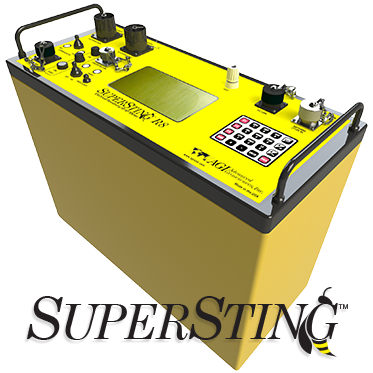
SuperSting R8 IP
The new SuperSting R8/IP 8 channel multi-electrode resistivity and IP imaging
system released at SAGEEP 2000 continues to sell all over the world.
The SuperSting is a breakthrough product from the market leader Advanced
Geosciences. It just got up to 8 times faster to perform a
resistivity imaging survey!
Most multi-electrode resistivity instruments are one-channel instruments and
therefore take one reading for each current injection.
The SuperSting is an 8-channel instrument and can therefore take up to eight
readings for each current injection and is thus up to eight times faster
than the one-channel instruments. So, if you want to be among those who will get
the competitive edge first, then contact our sales ASAP!
The SuperSting also incorporates productivity features designed to enhance
efficiency in the field for companies doing resistivity and IP imaging surveys.
Such features are; selectable electrode spacing in the instrument, built in
roll-along, possibility to shut off electrodes in case the profile ends up
against an obstacle, re-addressing of the electrodes in the field and much more.
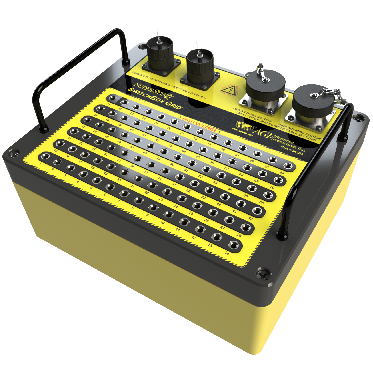
For customers who prefer a central switching system with passive electrode cables
we have a number of Switch boxes available with capability to switch 28, 56,64,84
and 98 electrodes. For more electrodes a number of Switch boxes can be connected to
each other. The Switch box is especially valuable when performing borehole to
borehole measurement with downhole electrode cables or for underwater measurements
with passive cables.
Key Advantages:
- 8 receiver channels for simultaneous data acquisition reduce number of reading cycles by 8!
- High power transmitter (200W!) makes it easy to record quality data on sites where previously only
time consuming stacking of many readings was possible.
- Possible to use 24 V batteries to increase available power!
- Integrated controller for the Multichannel Swift Dual Mode Automatic Multi-electrode system (US patent 6,404,203).
Reduces number of boxes to handle in the field.
- Simultaneously measures resistivity and IP with 6 time slot chargeability readings on all 8 channels!
- Uses the NEW SuperSting Swift cable with automatic dual mode electrodes (US patent 6,404,203) to
record 8 readings for each current injection.
|
SuperSting R1/IP Single Channel Resistivity Instrument
|
The SuperSting R1/IP is a single-channel version of the
8-channel SuperSting R8/IP.
Many characteristics are the same for both instruments including the remarkable measuring sensitivity.
Features:
-
The SuperSting R1/IP is a single channel automatic resistivity, SP and IP imaging system,
used with the patented (US patent 6,404,203) AGI dual mode multi-electrode system or with a Switch box
and passive electrode cables.
-
This resistivity meter can be used for automatic resistivity and IP imaging in: 2D, 3D, resistivity monitoring,
underwater, marine and bore-hole to bore-hole applications.
-
The SuperSting R1/IP has a set of stored command files for different electrode arrays such as
Schlumberger, Wenner, dipole-dipole, pole-dipole and pole-pole.
-
The instrument can be programmed to perform any type of resistivity/IP survey automatically.
-
Roll-along and selection of electrode spacing from keyboard without cumbersome command files.
-
Used for resistivity, SP & IP imaging in applications such as groundwater exploration,
geotechnical investigations, horizontal drilling, mapping of pollution plumes,
cavity detection, archeological and environmental work etc.
|
Ministing Single Channel Low-Cost Instrument
|
The MiniSting is a development of the famous Sting R1 resistivity meter. By introducing less expensive
production methods and design, we have been able to reduce the price of the instrument.
Features:
- The instrument measures resistivity, SP (self potential) and IP (induced polarization).
- Can be used with our patented (patent 6,404,203) automatic dual mode smart electrode system.
- Can be used with our Switch boxes (28, 56, 64, 84 and 98 electrode capability) and passive electrode cables or our down-hole cables.
- Rugged construction.
- Delivered with the Administrator utility software for downloading data and uploading command files and more.
|
SuperSting Marine System

|
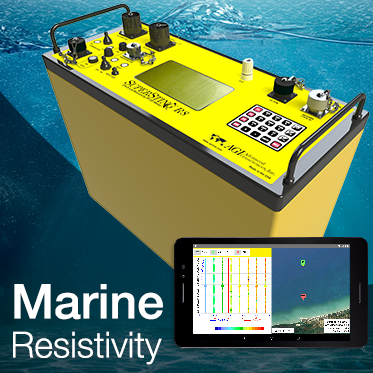
AGI has developed a new marine option of the famous SuperSting R8. The system comprises the
SuperSting Marine, the Marine Log Manager software and an electrode towing cable.
The SuperSting Marine continuously records and stores data from a GPS receiver.
Current is injected every 3 seconds and 8 apparent resistivity values representing 8
depth levels are read for each current injection. Depth of penetration depends on length
of the cable and array type. Typically you will see down to aproximately 20% of the
electrode spread length.
The Marine Log Manager software allows you to edit the recorded data, plot the boat
track and the resistivity data on an imported map image and to format the data for the
EarthImager 2D inversion software. Electrode positions can also be converted to UTM coordinates.
The electrode cable features graphite electrodes (US Patent 6,674,286), a kevlar strength
member and water block. The advantage of the graphite electrodes is that they do not
corrode as currrent is passed through them. Regular metal electrodes quickly corrodes
in water environment due to electrolysis processes. The water block prevents water from
entering the cable in case of a cut in the outer jacket.
|
AGI Resistivity Imaging Inversion software
EarthImager 2D

|
The EarthImager 2D
is the new standard for affordable Resistivity Imaging
software from Advanced Geosciences.
With this software data collected with the AGI SuperSting earth imaging resistivity instruments
can be interpreted into easy to read 2D earth sections. The processed data can be output to varius
types of files and can be processed into reports ready for submission to the client.
Features:
- 2D resistivity and IP inversion software.
- 2D ERT (electrical resistivity tomography) between two or more boreholes and surface electrodes.
- Survey planner with graphical model input, forward modelling, inversion and virtual survey with actual command file.
- Data editing for detecting and removing erroneous data points.
- High definition report quality plat style printout.
- Topographic correction and printout of resistivity section with topographical features.
- Finite difference and finite element modelling.
- No software limit on number of data or number of electrodes.
- No limit on array type or electrode location.
- User friendly Windows GUI.
- Fast graphics Windows 32-bit program.
- A graphical a-priori information input interface.
- Real time scrolling through all iterations using the mouse wheel, creates “movie like” animation.
- Seamless operation with AGI resistivity instruments.
- Removable contour curves and automatic blanking.
- Windows true type font and true 24-bit color.
- Continuously developed with updates available to registered users via the AGI website.
Get a demo of EarthImager 2D!
|
EarthImager 3D
|
The EarthImager 3D is our 3D resistivity imaging inversion software.
Our EarthImager 3D resistivity and IP inversion software (IP data inversion is coming soon)
inverts resistivity and IP data acquired with electrodes arranged in boreholes and/or on the
surface and presents a 3D volume of inverted resistivity data with advanced volume rendering
technique. The final resistivity or IP image-volume can be rotated in any orientation, zoomed
in and out, and translated to anywhere inside the image window in order to see the volume of
interest in detail. Colors representing areas of less interest can be made transparent so that
the shape of a pollution plume, for example, can be visible. With EarthImager, 3D resistivity
inversion can be as easy as two steps: Read Data and Start Inversion with only a few mouse clicks.
|
AGI Resistivity Imaging Cable Systems
AGI produces cable systems for all of the resistivity imaging instruments (SuperSting R8/IP,
SuperSting R1/IP, MiniSting and the older Sting R1 and Sting R1/IP).
Cable types
The cable systems are manufactured in two types, the distributed electrode switch type and the
central switching box type. Both can be used separately or in combination.
The advantage of the switch box type is that a more light weight and less expensive multi-channel
cable can be used. The dual-mode switch is however only available in the distributed switch cables.
For imaging projects where the survey conditions are favourable and production speed is imporant
we recommend using the switch box cable system with the lightweight and less expensive cables.
Switch types
There are two types of switches used, the single channel switch originally designed for the
Sting R1 instrument and the multi-channel switch designed for SuperSting R8/IP. Both types
can be used by the SuperSting instruments, but the MiniSting and older Sting instruments can
only use the single-channel switches.
Note that when Sting R1 cables are used with the SuperSting R8/IP the instrument will only
record data in single channel mode.
The distributed cable switches come with the dual mode operation possibility, which is currently
not available in the switch box version. The dual mode operation makes it simpler to obtain high
quality readings in conditions where electrode polarization is a problem.
 |
Switch boxes
Switch box systems are used to control electrode connections via passive cables.
Such cables can be made considerably more light-weight and can be used in many common
survey situations.
|
 |
Swift Dual Mode Automatic Electrode Cable
The dual mode electrode (US Patent 6,404,203) allows the user to measure IP using non-polarizable electrodes in an
automatic electrode system and at the same time use stainless steel electrodes for current
transmission. By using non-polarizable electrodes, a much better signal can be recorded, free
from the polarization noise of a stainless steel electrode. You will not find this feature on
any other resistivity/IP system!
We have designed the Dual Mode Electrode system to be easy to operate in the field. One single
setting in the SuperSting allows you to select whether to perform a survey with only stainless
steel electrodes or with the combination dual mode stainless steel/non-polarizable electrodes.
Therefore, it is not necessary to always use non-polarizable electrodes if the survey
specification does not call for it.
The Swift dual mode automatic electrode cable is backwards compatible with the Sting R1
and the old Swift system. We will gradually phase out the old type Swift electrode cable and completely replace
it with the new Swift Dual Mode Electrode cable.
|
AGI information
Advanced Geosciences, Inc. (AGI) with headquarters in Austin, Texas, specializes in manufacturing and
development of high-resolution geophysical instruments for resistivity and IP imaging.
AGI manufactures the SuperSting R8/IP, SuperSting R1/IP and MiniSting earth resistivity imaging systems
and the EarthImager 2D and 3D inversion software for processing of the recorded data.
Typical applications for the AGI systems include:
- Geotechnical investigations
- Construction site investigations
- Borehole to borehole and borehole to surface tomography imaging
- Fracture and cavity detection in bedrock
- Groundwater exploration
- Environmental investigation (i.e., mapping of pollution plumes, etc.)
- Investigation of dam leakage
- Sand and gravel exploration
- Site characterization for development
- Site investigation for horizontal drilling
- Site investigation for tunneling operation
- Marine image profiling using our unique SuperSting Marine system
- Archeological studies.
The DC resistivity imaging method is especially valuable in areas where ground penetrating radar (GPR)
and EM methods do not work because of conductive overburden.
Conductive materials, for example clay, attenuates the radar (EM) signal so that no result,
or very limited result, can be achieved. In such areas, which are very common in large areas
of the world, the resistivity method is the only real alternative for subsurface 2D and 3D
mapping of the near surface.
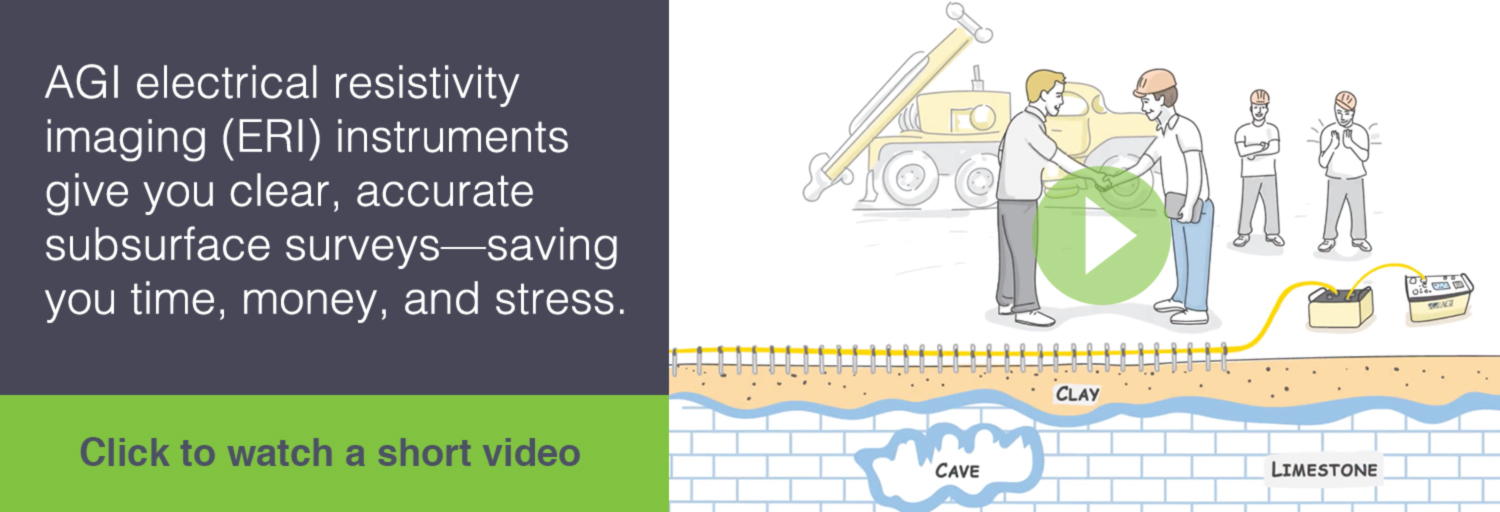
Field procedure is simple. First set out electrode stakes at even intervals.
Then lay out the electrode cable and attach each take-out to the stakes.
Finally connect the AGI instrument (any of the above listed ones) to the electrode cable, perform an
automatic test to check that everything
is connected correctly and then start the automatic recording.
The resistivity measurements are stored directly in the memory of the instrument.
When the field measurement is complete the data are downloaded to a PC computer,
inverted from apparent resistivity into "true" resistivity and presented as a color
cross-section of the subsurface.
Being an instrument manufacturer and not wanting to compete with our customers,
AGI does not perform electrical resistivity surveys. Therefore, the examples and
case histories on this web site is recorded and produced by our clients, whom we
now thank for their valued contribution.
We are available during Texas office hours 8:30-17:00 CDT (= GMT-6) on the phone number
below. You can use our fax line or send us e-mail too.
- Telephone
- +1-512-335-3338
- FAX
- +1-512-258-9958
- Postal address
- 2121 Geoscience Dr., Austin, TX 78726, USA
- Electronic mail:
- General Information: info@agiusa.com
Sales info & order: sales@agiusa.com
Customer Support: support@agiusa.com
Webmaster: webmaster@agiusa.com
Last modified:
2008-01-09 17:16:27 EST

Copyright 1999 Advanced Geosciences, Inc
|